Why One Circuit’s Lights Flicker: Utility, Breaker, or Panel?
Lights flickering on just one circuit? Learn how to tell if it’s your utility, a bad breaker, or a failing electrical panel—and what to do next.
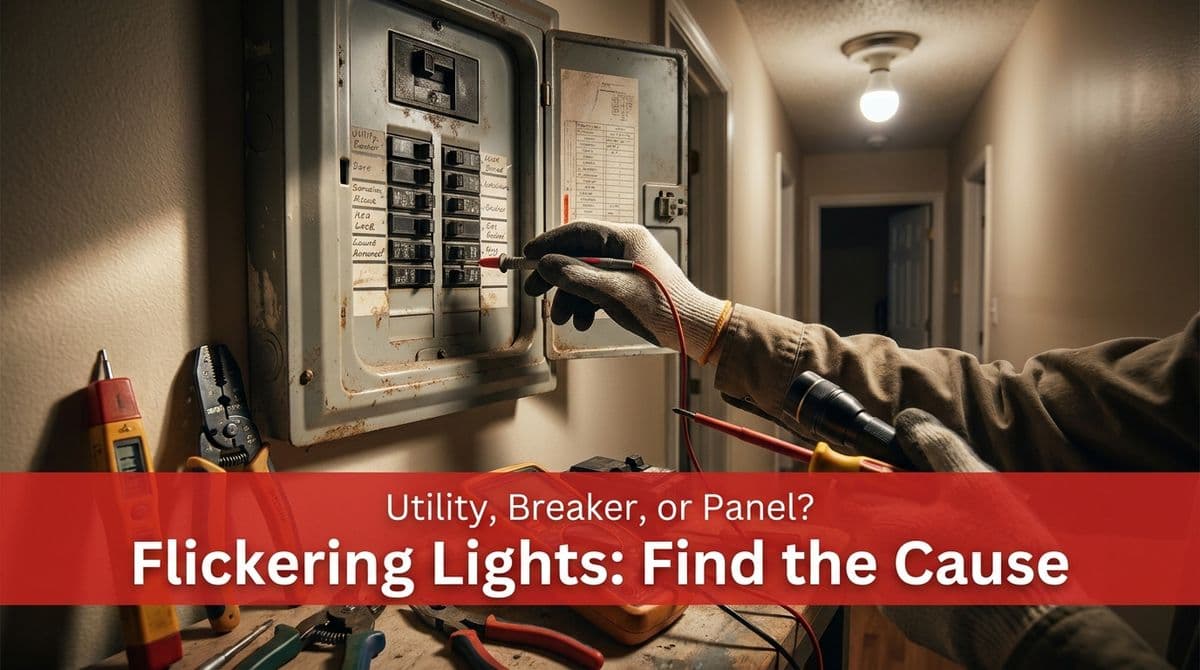
A Flickering-Light Call From a Landlord
We recently got a call from a landlord — let’s call him Mike — who was pretty frustrated with a strange problem in one of his rental units. His tenants had lived there for over a year with no issues, and then, out of nowhere, lights on one circuit started flickering.
On that circuit, a hall light and a lamp with smart bulbs would sometimes do what the tenants called a “flicker,” but what Mike described as, “The thing went dark for a second and then came back on.” A plug-in fan on the same circuit would actually shut off and then restart. Mike did some homework himself, even watched the power at the breaker disappear and come back, and eventually swapped the breaker. The problem improved a lot, but that hallway light still had a faint, spooky little flicker.
Mike’s big questions for us were the same ones we get from a lot of homeowners: Is this my utility? A bad breaker? Or is my whole panel going bad?
Step One: Rule Out Whole-House & Plugged-In Causes
Before we jump to the panel or the power company, we like to work through a quick checklist — just like Mike and his tenants did:
- Is it the whole house or just one area? If lights all over the home are dimming or flickering, that leans more toward a utility or main service issue. In Mike’s case, it was one circuit.
- Is anything else on that circuit acting up? Here, the fan on the same circuit was shutting off and coming back on, which told us it wasn’t just a finicky bulb.
- Have you unplugged everything on that circuit? Mike had the tenants disconnect everything they could, and the hallway light still flickered. That helped rule out a bad power strip or a noisy plug-in device.
- Have you tried different bulbs? Smart LED bulbs can be especially sensitive to minor voltage changes. Swapping one for a basic incandescent or a standard LED can be a useful test.
If you get to the point where a hardwired light still flickers with nothing else plugged into the circuit, it’s time to look upstream: the breaker, the panel, or the power coming into the home.
When Flicker on One Circuit Is Still a Utility Problem
One thing that surprised Mike was our suggestion to call the utility early in the process. His thinking was, “If it’s only one circuit, how could that be the power company?” That’s a really common assumption.
Here’s what we explained: most homes are fed by a two-phase (split-phase) service. Your panel has two hot legs coming in. A problem on one leg — like a loose connection at the meter, on the service drop, or at the transformer — can create small voltage fluctuations that show up more noticeably on certain lighting circuits, especially those with LEDs or smart bulbs.
You might only notice it on one hallway light, but that doesn’t mean the fluctuation isn’t happening elsewhere. Motors (like fridges or fans) can ride through minor sags with no obvious sign, while sensitive electronics or LEDs twitch just enough for your eye to catch.
As a general rule, we encourage homeowners to contact the utility when:
- You see voltage clearly fluctuating at the breaker (with a proper meter), not just at a light.
- Multiple neighbors report similar issues.
- Lights brighten and dim noticeably when large loads (AC, oven, dryer) kick on.
The good news: a utility voltage check is typically free, and if they find a loose connection or failing equipment on their side, they fix it.
Signs You’re Dealing With a Bad Breaker or Bus Bar
In Mike’s case, one key detail was that he actually watched the power at the breaker disappear and come back. After that, he replaced the breaker, and the problem got mostly better. That told us two things:
- The original breaker almost certainly had an intermittent internal failure or poor connection.
- The improvement after changing the breaker meant we were on the right track, but something upstream could still be compromised.
On older panels, especially ones from brands that have been bought out or discontinued, the way the breaker clips to the bus bar isn’t always great. Mike described a panel where the bus bar almost “swung” like a pendulum when he tried to remove the breaker — not what we like to see. That kind of movement and flimsy design can lead to:
- Loose breaker-to-bus connections
- Corroded or “cruddy” contact surfaces
- Heat damage on the bus bar over time
When we hear that a new breaker helped but didn’t completely fix the flicker, we start to suspect the bus bar itself. The fresh breaker has clean clips and may bite into a slightly better spot, but if the bar is pitted, oxidized, or heat-damaged, that connection may never be fully reliable.
Can Cleaning the Panel Fix the Flicker?
With some panels, we can safely remove the breakers, expose the bus bars, and clean the contact surfaces to restore a solid connection. That’s something Mike had tried on other panels in the past with mixed results.
Here’s how we usually approach it:
- We inspect the interior of the panel for discoloration, signs of arcing, or warped bus bars.
- If the bus looks structurally sound, we may clean and re-seat the breakers and test under load.
- If we see heavy pitting, melted spots, or movement like what Mike described, we start talking about panel replacement rather than just cleaning.
For a homeowner, this is not a DIY step. Taking breakers out of a live panel and working around energized bus bars can be extremely dangerous. At that point, it’s time to bring in a licensed electrician to take a close look and document what’s going on.
When It’s Time to Replace an Old or “Wanky” Panel
Mike’s sub-panel was an older style in a condominium unit, fed from a main breaker down in a utility room. The brand was older and no longer in production, and the way the breaker clipped in was, in his words, “really wanky.” When a panel is:
- Old, discontinued, or known for poor connections
- Physically loose or flexing when breakers are removed
- Showing ongoing issues even after new breakers are installed
then upgrading the panel often becomes the safest, most long-term solution. We understand the hesitation — cutting drywall, matching texture, and working inside a finished space isn’t anyone’s favorite idea. In most modern drywall homes, though, we can usually keep the opening modest and handle a basic patch ourselves, especially when the panel is tucked behind a door or in a low-visibility area.
We walked Mike through that reality: if the bus bar is too far gone, no amount of new breakers or cleaning will restore a truly reliable connection. At that point, you’re better off investing in a new, solid panel rather than chasing intermittent flickers for years.
What You Can Do If One Circuit Keeps Flickering
If you’re noticing flickering on just one circuit, here’s the step-by-step path we recommend:
- Document the problem. Note which lights/outlets are affected, how often it happens, and whether anything else is running when it occurs.
- Try simple swaps. Replace smart bulbs or LEDs with a basic bulb to see if the flicker is just sensitivity, not a power issue.
- Unplug everything on that circuit. See if a hardwired light still flickers with nothing else connected.
- Call your utility. Ask them to check for loose connections or voltage issues at the meter and on their equipment.
- Have an electrician inspect the panel. Especially if the breaker itself seems to lose power or if it’s an older, questionable panel.
If you’re seeing the same kind of behavior Mike saw — breakers that seem to drop out and come back, old or flimsy panels, or minor flicker that persists even after a breaker change — we’re happy to take a look, review photos of your panel, and help you decide whether cleaning, repairs, or a full panel upgrade makes the most sense.
Flickering lights aren’t just annoying; they’re your home’s way of telling you something. With a little detective work and the right testing, we can track down whether the culprit is the utility, a bad breaker, or a failing electrical panel and get your lights steady again.