Why Your EV Charger Is Raising Your Electric Bill
Wondering why your EV charger is driving up your electric bill? We explain how panel connections, solar, batteries, and breakers affect what you really pay.
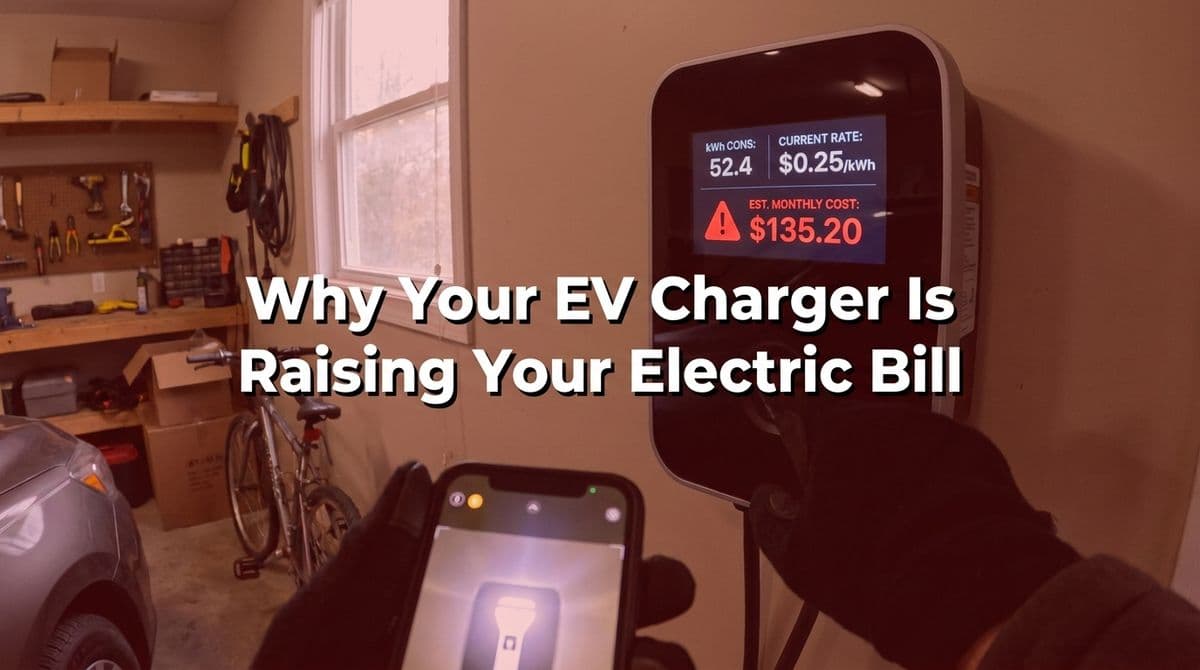
We recently got a voicemail from a customer — we’ll call him Mark — who was more than a little frustrated with his EV charger. We had installed a charger at his home, and now he was seeing electric bills jump by a few hundred dollars a month. On top of that, his charger was stuck at a low amperage, and he wasn’t sure which breaker controlled it so he could reset it like Tesla support had suggested.
Mark also had solar and a battery system. He was convinced the car was pulling power from the grid instead of his solar and storage, and he wanted to know exactly how we tied the charger into his electrical system — solar panel side or grid side — and why Edison seemed to be cashing in while his battery sat there doing nothing.
Understanding Why EV Chargers Affect Electric Bills
We walked Mark through something most EV owners discover the hard way: an electric vehicle is basically another major appliance, closer to an electric dryer or mini air conditioner than a phone charger. When you plug into a Level 2 charger, you’re often pulling 30–50 amps for hours at a time.
Even if everything is wired perfectly, that kind of load will show up on your bill. But there are a few key factors that determine whether your EV charging feels reasonable or “my family is out of their minds about the bill” expensive:
- How many miles you’re charging each day
- Whether you’re on a time-of-use (TOU) rate plan
- How your charger is connected to your panel and solar system
- How your breaker and settings limit (or don’t limit) the charging amperage
How Panel Connections and Solar Routing Affect Charging Costs
One of Mark’s biggest questions was “Is my car charging from solar and battery, or straight from the grid?” That comes down to how the charger is tied into the panel and how the solar system is designed.
Common ways EV chargers are connected
In a typical home with solar, there are two main setups:
- Standard grid-tied solar (no whole-home backup): The EV charger is usually connected to the main service panel, just like the rest of the house. Your solar backfeeds into that panel. During the day, solar reduces how much you pull from the grid, but at night most charging comes from utility power.
- Solar with batteries / backup loads panel: Some or all of the home’s circuits are moved to a backup loads or critical loads panel that the batteries support. Depending on design, the EV charger may be on that backup panel (so it can use battery power) or left on the main panel (so it doesn’t overwhelm the battery system).
If your EV charger is on the main panel while your batteries only support a backup panel, your car will mostly charge from the grid, not the batteries — exactly what Mark was worried about.
Why your EV might not be using your solar the way you expect
Even when the charger is wired correctly, a few things can make it feel like you’re not using solar:
- Charging at night: No sun means no direct solar production. You’re using grid power unless your batteries are sized and configured to feed the charger.
- Solar output vs. charger draw: A 40-amp charger at 240V can draw about 9.6 kW. If your solar array is 5–6 kW, the charger will easily exceed your solar production, and the extra comes from the grid.
- Battery programming: Some battery systems are intentionally set not to support large loads like EV chargers to preserve backup runtime.
When we review a setup like Mark’s, we look at how the charger breaker is landed in the panel, how the solar backfeeds, and what the battery backup scheme is. That tells us quickly whether the car can realistically be powered by solar/battery or if it’s mostly grid-fed.
Finding the Correct Breaker for Your EV Charger
Mark also needed to know which breaker actually controls his charger so he could shut it down and reset it per Tesla’s instructions. That’s a common question, especially when panels aren’t well labeled.
A safe way to identify your EV charger breaker
If you’re not comfortable around electrical panels, we always recommend calling a licensed electrician. But if you are reasonably familiar and want to identify the breaker, here’s the process we usually talk homeowners through:
- Turn off the car’s charging session from the app or car screen.
- Go to your main service panel. Look for a double-pole breaker (a tied-together pair) typically rated 40A, 50A, or 60A and labeled “EV,” “Car Charger,” or similar.
- If labels are missing or unclear, we shut off one suspect double-pole breaker at a time while someone by the car watches to see when charging power drops out.
- Once located, we clearly relabel that breaker for future reference.
Once you’ve found the breaker, you can follow manufacturer instructions: turn the breaker off, wait 30–60 seconds, then turn it back on to reset the charger. That’s often all it takes to clear minor communication or amperage issues like the 6-amp limit Mark was seeing.
Why Your EV Charger Might Be Stuck at Low Amps
Mark’s car would not pull more than 6 amps, which is basically a trickle. That can usually be traced to:
- Car settings: The EV may have a max amperage setting for a location. If it was manually reduced once (say, to avoid tripping a breaker), the car might “remember” that lower setting.
- Charger configuration: Many wall connectors have an internal dial or software setting that limits maximum current based on breaker size.
- Breaker sizing mismatch: If the charger is configured for more amperage than the breaker and wiring safely allow, it can self-limit to avoid nuisance trips.
We typically double-check car settings, confirm the charger’s internal amperage configuration, and verify breaker size and wire gauge. Once all three are aligned, most charging speed issues disappear.
Tips to Keep EV Charging Costs Under Control
If you’re seeing bills like Mark’s and wondering what you can do, we usually walk homeowners through a few simple steps:
- Use time-of-use plans: Ask your utility about EV or TOU rates and schedule charging during off-peak hours.
- Right-size your charger: You may not need 48 amps every night. Dropping to 24–32 amps and charging longer can ease strain on your system and battery.
- Coordinate with your solar and battery: A licensed electrician can evaluate whether moving the charger to a backup panel, changing priorities, or adding capacity makes sense.
- Label your panel: While we’re on-site, we always label the EV breaker clearly so reset steps are simple in the future.
If your EV charger is giving you sticker shock on your electric bill — or you’re not sure how it’s tied into your solar and panel — we’re always happy to take a look, explain the setup in plain language, and recommend the most cost-effective way to charge at home.